


Vanessa Nakate :The Voice of a Continent

The Introduction
Among the many contemporary climate activist voices echoing around the globe, perhaps none have resonated as strongly with moral urgency and necessity as Vanessa Nakate. She is a young woman from Uganda who initially protested on her own outside the Ugandan parliament building, however she has rapidly become one of the leading figures in today’s global environmental activism. Her story does not simply reflect her individual courage, but rather represents the power of representation. As we continue to view the climate crisis from the lens of Western science and politics, Nakate has compelled us to see the “Global South” (especially Africa) not only as victims of disaster, but as sources of resilience, wisdom, and leadership.
She has overcome erasure in her life. From protesting alone in Kampala, to having her face cropped off by international media, Nakate has had to advocate for herself and earn her right to be at the table. And while she could have retreated from those experiences, instead, she amplified her message which now resonates from the halls of the UN to the rural schools of Uganda.
Early Life and Education
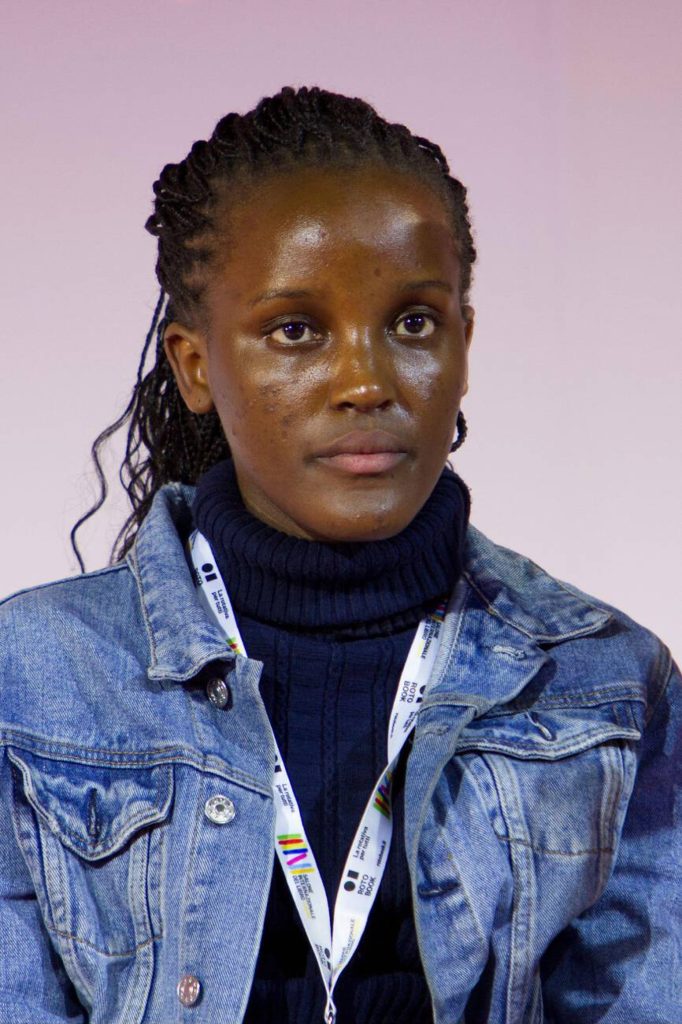
Vanessa Nakate was born on November 15, 1996, in Kampala, Uganda. The first child of five children, she grew up in the vibrant and active neighborhood of Kitintale within the capital city of Uganda. Kampala is a city with an energetic atmosphere that is similar to much of Africa—rapidly evolving. Her father, a local businessperson and president of his local Rotary Club, instilled a strong commitment to community service within her; while her mother’s quiet strength has served as a solid base for the resilience that Vanessa would have to utilize.
Nakate did not become an activist until later in life, specifically while attending Makerere University Business School (MUBS) in Uganda, where she studied business administration, focusing on marketing, and received a bachelor degree in this field. She is a dedicated student, and by her own admission, was quite reserved and shy—and therefore it is all the more extraordinary how she has progressed to be a well-known and influential global public speaker.
In 2018, just before her graduation from MUBS in January 2019, Nakate’s world view began to shift. Nakate became increasingly concerned about the unseasonably warm temperatures that were present in Kampala. She began to ask questions that went beyond the weather forecasts. Why were the temperatures so excessively high? Why were the rains so unpredictable in a country that relies so heavily upon its agricultural production?
She conducted research into the cause of these extreme weather conditions. She found that the flooding, landslides, and droughts that are causing devastation to communities throughout Uganda are not random “acts of God”, but rather a result of the warming of the planet.
Furthermore, she understood the deeper injustice at the core of the climate crisis: Uganda, and Africa as a whole, account for less than 3% of global carbon emissions, and they are experiencing the worst of the consequences of this issue. It was this understanding that her people are paying the price for the excessive use of industry in the Global North that ignited a fire in her.
The First Protest

Late 2018, Nakate felt a sense of urgency after seeing the one-woman protests of Swedish activist Greta Thunberg. She knew she had to take action too. However, she was acutely aware that the political landscape of Uganda was far removed from that of Sweden. Public demonstrations were viewed skeptically in Kampala, and protesters frequently faced police intervention. There was an honest-to-goodness possibility of being arrested, and there was also great social stigma attached to a young woman standing on a street corner with a protest sign.
Initially, Nakate recruited some of her siblings and cousins to help her. They assembled their materials, painted their protest signs, and planned to stage a march at the end of a Sunday in January of 2019. When the day arrived, the group’s fear took hold. The group was worried about how the general population would react. Ultimately, Nakate determined that if she was going to lead, she may need to do it by herself.
Although she wasn’t completely alone for her first protest outside of the Ugandan parliament building, a small number of brave relatives supported her. As the weeks passed by, the crowd diminished significantly. Many times, Vanessa Nakate stood under the equatorial sun with only her sign reading “Green Climate, Clean Future.” She was mocked by passers-by. She was questioned by security guards. Many people told her that she was throwing away her time – that a girl such as herself should be finding a husband, a job or other means of supporting herself rather than standing in the street with a sign.
Regardless of the discouragement, she continued. Every week on Fridays, she protested, documenting her actions via social media. Twitter (X), ultimately, was Nakate’s megaphone. Over time, the online community began to notice her persistent activism. Her clear and concise statements explaining the significance of the Congo Rainforest attracted increasingly larger numbers of international supporters. She was no longer simply a girl from Kampala – she was now the face of a developing African youth climate movement.
The Congo Rain Forest Campaign
Nakate’s first major campaign was The Congo Basin Rainforest campaign. Often overlooked as being less important than the Amazon, The Congo Basin Rain Forests are the second largest tropical rainforests on Earth and an essential Carbon Sink for the health of our planet. While the rest of the world was focused on the fires burning in the Amazon and the destruction of Notre Dame Cathedral in Paris during 2019, the Congo rain forest was also burning.
Nakate campaigned to raise awareness about the ecological disaster happening to the Congo rain forests. She emphasized that saving the Congo rain forest was not just an African issue but a global imperative. As a result of Nakate’s campaign efforts, the global environmental community began to take notice of the importance of preserving Africa’s ecosystems and their role in maintaining global climate stability.
The Turning Point: Davos 2020
January 2020 was the year the world would be forced to pay attention to Nakate. Nakate was invited to the World Economic Forum at Davos, Switzerland. This was one of the first times a young Ugandan woman had been included at the exclusive table of the worlds wealthiest and most influential people.
At the WEF in Davos, Nakate joined Greta Thunberg, Loukina Tille, Luisa Neubauer, and Isabelle Axelsson for a joint press conference. The five activists all represented different regions of the globe; however, they all shared a common interest in advocating for climate action.
After the press conference, the activists took a group photo together. The photo taken against the backdrop of snow was later released to the Associated Press (AP).
However, when the AP released the group photo, Nakate was no longer visible in the photo. She had been cropped out of the left side of the frame. The resulting published photo was only the four white European activists.
When Nakate saw the photo, it was not just a poor cropping job, it was the removal of an entire continent.
the video was an open letter to the agency and the world, chocking back tears and asking “does this mean I have no value as an African activist? or do the people from Africa have no value at all?”
her statement “you didn’t just erase a picture of me, you erased a whole continent”, went viral and created a global conversation about race, representation and how race intersects with the environmental movement. Nakate uncovered a painful truth that even when fighting to save the earth black/brown voices were being marginalized out of the movement. the ap eventually apologized and put a different picture up, however the harm/damage and lessons learned were already done. Nakate made herself visible, and through doing so she became a symbol of the fight for climate justice (not just climate action).
“a bigger picture”

the davos event could have ended with nakate defeated. instead she used it as fuel. in 2021 she released her memoir and manifesto, a bigger picture: my fight to bring a new african voice to the climate crisis.
the book is a very strong critique of the white savior mentality that is found in international aid and many forms of activism. Nakate’s argument is that the global south does not need westerner’s flying into save them; they need access to the resources and the platforms needed to find their own solutions. Nakate uses examples of the specific ways climate change has affected the lives of women and girls in africa and links these effects to poverty, early marriage and lost education opportunities.
a bigger picture is much more than a story of her life, it is a call for a type of environmentalism that is anti-racism, inclusive and will recognize that there is no climate justice without social justice. the book received critical acclaim and solidified her position as an intellectual leader in the environmental justice movement.
Tangible Action:
vanessa nakate speech at COP26
Rise Up Movement and Vash Green Schools
Nakate has always said that words must also have actions behind them. In order to make sure African young people’s voices were heard internationally, Nakate created the Rise Up Movement, an organization whose purpose was to amplify the voices of African climate activists.
In addition to being an advocate, Nakate created the Vash Green Schools Project, which is a tangible representation of her ideas. The Vash Green Schools Project is focused on converting all of the public schools in rural Uganda to renewable energy.
Most of the schools in Uganda cook meals for their students using wood, and because of that they contribute to the deforestation and expose themselves and cooks (usually women) to harmful smoke from burning the wood. The Vash Green Schools Project replaces those firewood cooking stoves and provides the schools with institutional eco-friendly stoves and solar panels.
The results of the Vash Green Schools Project are numerous:
- Environmental: The less firewood that is used will result in fewer trees cut down, and lower carbon emissions.
Health: The improved air quality in the school kitchens will lead to fewer students and cooks having to suffer from respiratory illness. - Educational: The solar panels allow for electricity at the schools; therefore, the students can do homework before sunrise or after sunset, which will help improve their grades.
- Economical: The schools will save money by using less fuel, which can then be used to purchase additional educational resources.
The Vash Green Schools Project had converted over 50 schools in Uganda by the year 2024; thereby, positively affecting the lives of thousands of students. As stated previously, Nakate believes that true climate action means creating solutions to the many pressing human problems, while still working to protect the planet.
Climate Change and Gender
Gender and Climate Change is another important aspect of Nakate’s work. Nakate has been advocating for the education of girls as a major method to solve the climate problem. She references Project Drawdown who list educating girls and family planning as the number one solution to solving the climate crisis.
When Nakate explains this reasoning, it is very clear: girls that are educated are much less likely to get married until later in their lives, will have fewer and healthier children and will go into the workforce. As such, girls that are educated are much more likely to be able to adapt to climate-related disaster and to lead their communities through times of shock. On the other hand, when a family is hit by a natural disaster, the family may take their daughter out of school or marry her off so quickly because they need to raise money for a dowry to help ensure their son-in-law can provide for the family, which will trap the family’s future in a cycle of poverty.
“When we talk about climate justice, we also talk about gender justice,” she states. Her work further illustrates that women are often the majority of the people who farm and collect water in rural parts of many countries in Africa; and therefore, are also among those most impacted by climate change.
Recent Years: Oxford and Further Work
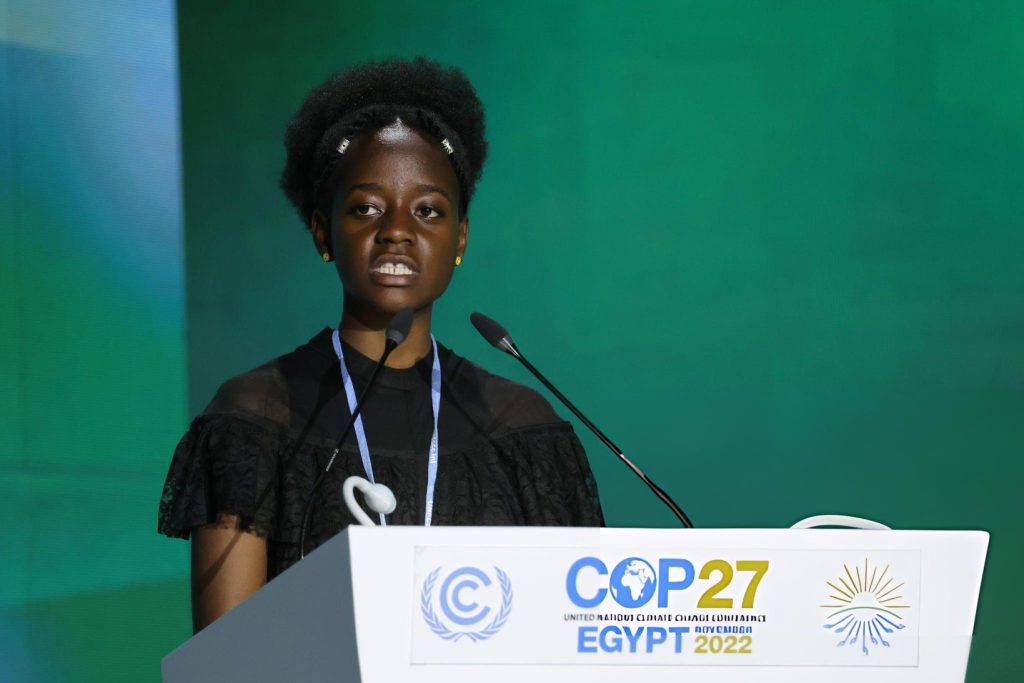
Since her book came out, Nakate has consistently spoken at the United Nations’ Conference of the Parties (COP) since then. At COP 26 in Glasgow, COP 27 in Sharm el Sheikh and COP 28 in Dubai, she acted as the moral conscience of the conference. While the politicians were arguing over decimal points in their proposed targets for reducing temperatures, Nakate spoke of the starving children in the Horn of Africa and the dry river beds of her home country. She called for “Loss and Damage” funds – money paid by developed countries to developing countries for the damage caused by climate change, which was finally created as a fund at COP 27 after years of advocacy from Nakate.
Recognizing that advocacy requires both passion and knowledge, Nakate made an important personal investment in herself when she received the Weidenfeld- Hoffmann Scholarship in 2023 and enrolled in a MPP program at the Blavatnik School of Government at the University of Oxford.
The choice to pursue education was deliberate. Nakate explained that she wanted to understand the “language of power” in order to be able to negotiate more effectively in rooms filled with people in positions of authority. As Nakate balanced the academic rigor of the Oxford program with her global activism, she continued to advocate through writing and public speaking. Nakate’s work bridged the gap between grassroots activism and high level policy making.
Nakate’s advocacy was recognized at the highest level. In 2022, she became a UNICEF Goodwill Ambassador. Nakate will receive an Honorary Degree (D.Sc. in Social Science) from the University of Edinburgh on November 20, 2024 for her significant contributions to climate justice. Nakate emphasized that the degree belonged not only to her, but to each and every young person who is currently working to create a better future.
Legacy and Future
At this time, (in 2026) Vanessa Nakate is one of the most prominent figures in the struggle for survival in the 21st century. Nakate has gone beyond being called an activist to becoming a representative of the planet. The movement for a new way of thinking about the environment is already beginning to change how people think globally, thanks in large part to Nakate. It is no longer possible to talk about the climate crisis without talking about Africa.
Nakate has also shown the world that the youth of the Global South are not passive recipients of aid or charity, but instead are powerful agents of change seeking justice.
From the empty street corner in Kampala to the lecture halls of Oxford, Nakate has been giving the world a larger view of the world – a world that includes voices that have historically been erased and silenced. A world where those who are typically marginalized will lead the way.


