

Early life
Hedy Lamarr was born Hedwig Eva Maria Kiesler, on November 9th, 1914, in Vienna, Austria-Hungary (today’s Austria), into an upper class, culturally rich family, where she was the only child of Emil Kiesler, a successful bank director from a Galician Jewish family and Gertrud “Trude” Kiesler (née Lichtwitz) a Hungarian Jewish concert pianist, who had converted to Catholicism. As a young child Hedy was taught piano, dance, and multiple languages and due to her wealth and education, was tutored privately throughout her youth. Her father, would often explain how machines functioned to encourage her interest in technology during their daily strolls, and her mother would encourage her to pursue her artistic interests. As a young child, Hedy Lamarr was fascinated with acting and theater. At the age of 12 she won a beauty contest in Vienna. As a teenager she began taking acting classes in Vienna and she forged a note from her mother to get hired as a script girl at Sascha Film, which led to small parts in such films as Money on the Street (1930) and Storm in a Water Glass (1931). Hedy also briefly studied acting with Max Reinhardt in Berlin. There is no credible evidence that Hedy Lamarr formally attended or studied at the Wiener Staatsoper (Vienna State Opera) for acting or music; Hedy’s training was informal and theater/film oriented.

Career
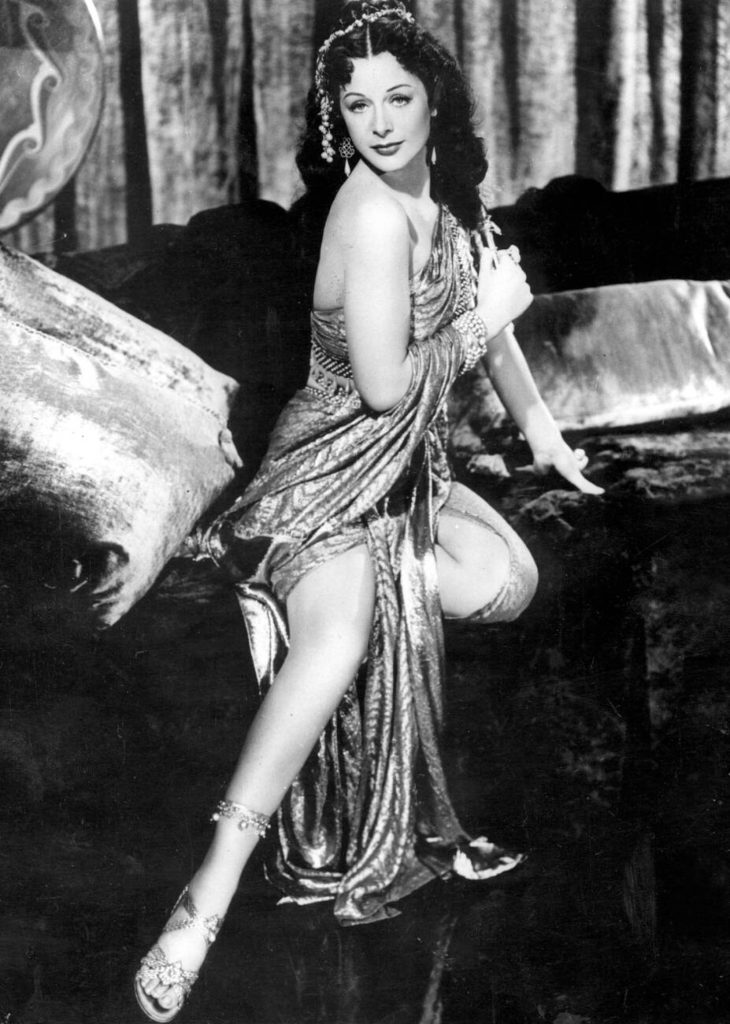
Hedy Lamarr started her professional acting career in Europe in the early 1930s. In 1933, she gained international fame for her lead role in the Czech-Austrian film Ecstasy, which featured very provocative scenes of nudity and implied orgasm. (She stated that many of these were filmed using deceptively long telephoto lenses.) The film won an award at the Venice Film Festival and was banned in numerous other countries for its graphic content. In 1937, after being freed from her first husband who had control over her, she relocated to Paris and then London and met with MGM studio executive Louis B. Mayer. He offered her a contract and recommended she adopt the stage name Hedy Lamarr, which he selected in reference to the silent screen actress Barbara La Marr, to help separate herself from the controversy surrounding the filming of Ecstasy. She traveled to Hollywood in 1938, and became an overnight sensation due to her American film debut in Algiers, and she received much praise for her exotic beauty and was frequently referred to as the “most beautiful woman in the world” during this time.During the 1940s, she acted in many of MGM’s top films including, Boom Town (1940) (along with Clark Gable and Spencer Tracy), Ziegfeld Girl (1941), White Cargo (1942), and Samson and Delilah (1949), (her most successful film financially), in which she played the role of Delilah. Throughout the 1940s she was constantly stereotyped as a sex symbol, which caused frustration with the limitations of her roles and ultimately led to her leaving MGM in 1945 to create her own production company and produce films including The Strange Woman (1946) and Dishonored Lady (1947). Her film career slowed in the 1950s, however she did have one final major role in 1958 in the film The Female Animal and made a cameo appearance in Instant Karma in 1990. She received a star on the Hollywood Walk of Fame in 1960.
Innovation and Development

Hedy Lamarr developed an innovative communication system with the help of George Antheil while she was married to her second husband. She utilized knowledge she learned from her first husband’s munition manufacturing business. They developed a frequency hopping spread spectrum method that synchronized both the transmitter and the receiver, which made it impossible for enemy forces to disrupt radio controlled torpedo signals using jamming techniques. The frequency hopping method was patented under her married name, Hedy Kiesler Markey, as U.S. Patent 2,292,387, on August 11, 1942.
The two presented their invention to the National Inventors Council in 1940, along with Cal Tech consultants. However, at this time, the U.S. Navy felt that the invention was too large for use on torpedos and therefore, they didn’t use the technology during the war. As a result, Lamarr never received any money for the invention and when the patent expired in 1945, her contributions to the field of communication remained unknown. Today, Lammar’s inventive concepts are the basis of many modern wireless devices such as Wi-Fi, Bluetooth, GPS, and secure military communication methods (which the U.S. Navy first began to utilize in 1962). Lammar was a self-educated inventor who had no formal education in engineering.
Personal life
The Lamarr’s marriage history is very complicated. She has been married to six different men: Fritz Mandl (1933-1937), who was an Austrian munitions magnate with strong fascist connections and abused Lamarr, causing her to flee in 1937, Gene Markey (1939-1941), who was a screenwriter, John Loder (1943-1947), who was an actor, Teddy Stauffer (1951-1952), who was a bandleader, W. Howard Lee (1953-1960), who was an oilman, Lewis J. Boies (1963-1965), who was her attorney. In addition to having one child that was adopted, the Lamarr also had one son, James, whom she never formally adopted, and therefore, he was estranged from her for many years. As a result of her tumultuous personal life, Lamarr experienced several other forms of turmoil throughout her life such as, a number of arrests due to shoplifting in 1966 and 1991 (the charges were eventually dropped), at least one lawsuit over her 1966 autobiography entitled “Ecstasy and Me” (due to misrepresentation), and one lawsuit in 1974 against Mel Brooks over a Blazing Saddles parody character (the case was settled).
Her Last Years and Her Impact on History

Lamarr lived in seclusion during most of her last years and moved from Miami Beach, Florida to Altamonte Springs / Casselberry, Florida due to her poor eye sight and declining health. She usually communicated over the telephone and was experiencing financial difficulties. It took many years for people to recognize Lammar’s invention. In 1997 she and Antheil both won The Electronic Frontier Foundation’s Pioneer Award. This made Lammar the first female recipient of the Invention Convention’s “Spirit of Achievement” award (usually referred to as the “Oscar Awards of inventions”) or also known as the Bulbie Gnass Spirit of Achievement Award. Lammar won the Victor Kaplan medal in 1998 in Austria. Lammar and Antheil were posthumously inducted into the National Inventor’s Hall of Fame in 2014 for Frequency Hopping Spread Spectrum Technology. Also, a Google Doodle was created in 2015 in honor of Lammar. A star has been named in Lammar’s name in 2019.
Legacy of Death and Fame
Hedy Lamarr passed away on January 19, 2000, at the age of eighty-five in Casselberry, Florida, due to heart disease. She wished that part of her ashes be put into the Vienna Woods and the rest would be interred in the Vienna Central Cemetery (Honorary Grave since 2014). Today, Hedy Lamarr is recognized for being both an iconic star of Hollywood’s Golden Era and one of the first inventors who helped lay the foundation of today’s wireless communications. A recent documentary about her called “Bombshell: The Hedy Lamarr Story” and many books about her have focused on her dual legacy, which has led to increased recognition of women’s contributions to STEM and the arts.